01 / RETRIEVE
Your knowledge, finally in context.
We map sources, permissions, freshness and intent before a model ever sees a question.
Generative AI systems · built to perform
Our generative AI development services take you from retrieval to rollout, turning fragmented knowledge into reliable AI products your teams can use, measure, and trust.





No hand-wavy chatbot experiments. Every component exists to make an answer more useful, safer, or easier to improve.
We map sources, permissions, freshness and intent before a model ever sees a question.
We compose retrieval, tools and human review into workflows that are explainable by design.
Real-world outcomes feed an operating loop, so the product gets better without becoming unpredictable.
A four-part engagement designed to replace uncertainty with proof, then turn proof into an operating system.
Spot the decisions and repetitive work where good context creates real value.
Ship a focused, production-shaped pilot around one measurable outcome.
Stress-test quality, safety, permissions and operational ownership.
Extend what works, using a clear roadmap and an evidence trail.
Bring us in for a focused need or keep us close from the first prototype to the millionth query.
Search, synthesis and grounded answers that give teams a trustworthy way to work with knowledge they already own.
Choose the use cases worth pursuing and define how success will be measured.
Coordinate reasoning, tools and review for work that needs more than a chat window.
Put quality, traceability, safety and cost into the product, not a side document.
Connect the right systems and leave your team able to operate what we build.
Embed generative AI directly into your product, from a working prototype to a release your team can maintain.
We keep an objective view of the stack: quality, latency, cost and control are all part of the conversation.
A knowledge assistant for a multi-market operations team, designed around questions that delay customer delivery.
The system combines internal playbooks, recent incidents and customer context with citations and clear hand-offs when a person should take over.
We design for environments where context, accountability and speed all matter at the same time.
Controlled knowledge for advisor and operations workflows.
Find and summarize approved information without losing the trail.
Give support and success teams a reliable second brain.
Make collective expertise easier to put to work.
Bring manuals, incident history and field knowledge together.
Speed up research while making sources and approvals explicit.
Help teams decide quickly with the right operational context.
Turn a growing knowledge base into a service people use.
Generative AI projects vary widely in cost. These are the factors that move the number, and we pin them down before giving a fixed price for the first use case.
An internal assistant used by your team needs less polish and fewer safeguards than a feature your customers use directly.
Clean, well-organized documents are quick to use. Scattered files, scanned PDFs and data locked in old systems add preparation work.
Higher accuracy targets need a larger evaluation set, more testing and often human review steps, which add build time.
Hosted APIs are fastest to start. Self-hosted open models cost more to set up but can be cheaper at high volume or required for data control.
Short answers to the questions we are usually asked before an engagement begins.
We begin with a focused discovery to identify the decision, knowledge, and success measure that matter most, typically followed by a working pilot within 4-6 weeks.
Retrieval-Augmented Generation connects a language model to your own documents through a vector database, so answers are grounded in verified content rather than the model's general training data — the single biggest lever for reducing incorrect answers.
A chatbot answers questions. An agent plans and executes a sequence of steps against defined tools and systems, within explicit limits on what it's permitted to do, and reports back what it did.
Yes. We design around the systems, permissions, and operating practices you already have. OpenAI, Anthropic Claude, Google Gemini, and open-weight models are all considered, chosen on evidence rather than preference.
We define evaluation sets, groundedness checks, and human review points before launch, and score every candidate model on accuracy, latency, cost, and governance fit.
Yes. Enablement, documentation, and a clear operating owner are built into every engagement, not left as an afterthought.
Building applications that use generative AI models to write, summarize, answer questions or extract information from your own data, such as internal assistants, document processing and customer support tools, with the testing and controls needed to run them in production.
It depends on the use case, the data involved and the accuracy required. A focused internal assistant over your documents is a much smaller project than a customer-facing product. We scope a first use case and quote a fixed price for it.
A first focused use case typically reaches a working pilot in weeks, not months. Wider rollouts follow once the pilot proves its value on real users.
Yes, when it is built properly: your data stays in your cloud, access follows your existing permissions, and we use model providers and settings that do not train on your data.
You do. Source code, prompts, evaluation sets, trained model weights and documentation are handed over and belong to you, and we sign an NDA before any detailed discussion.
We'll help you frame the opportunity, identify the constraints and decide what a useful first proof should look like.
Tell us what your team needs to know, decide or deliver faster.
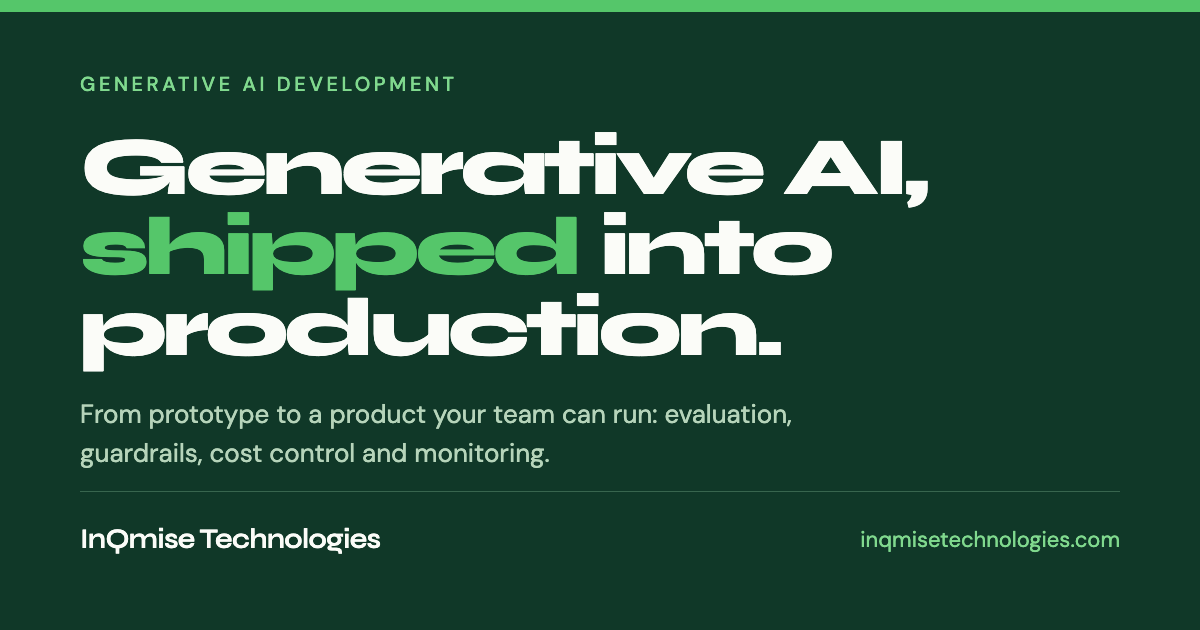
Generative AI development services in India, from prototype to production with guardrails and monitoring.
Download this card